
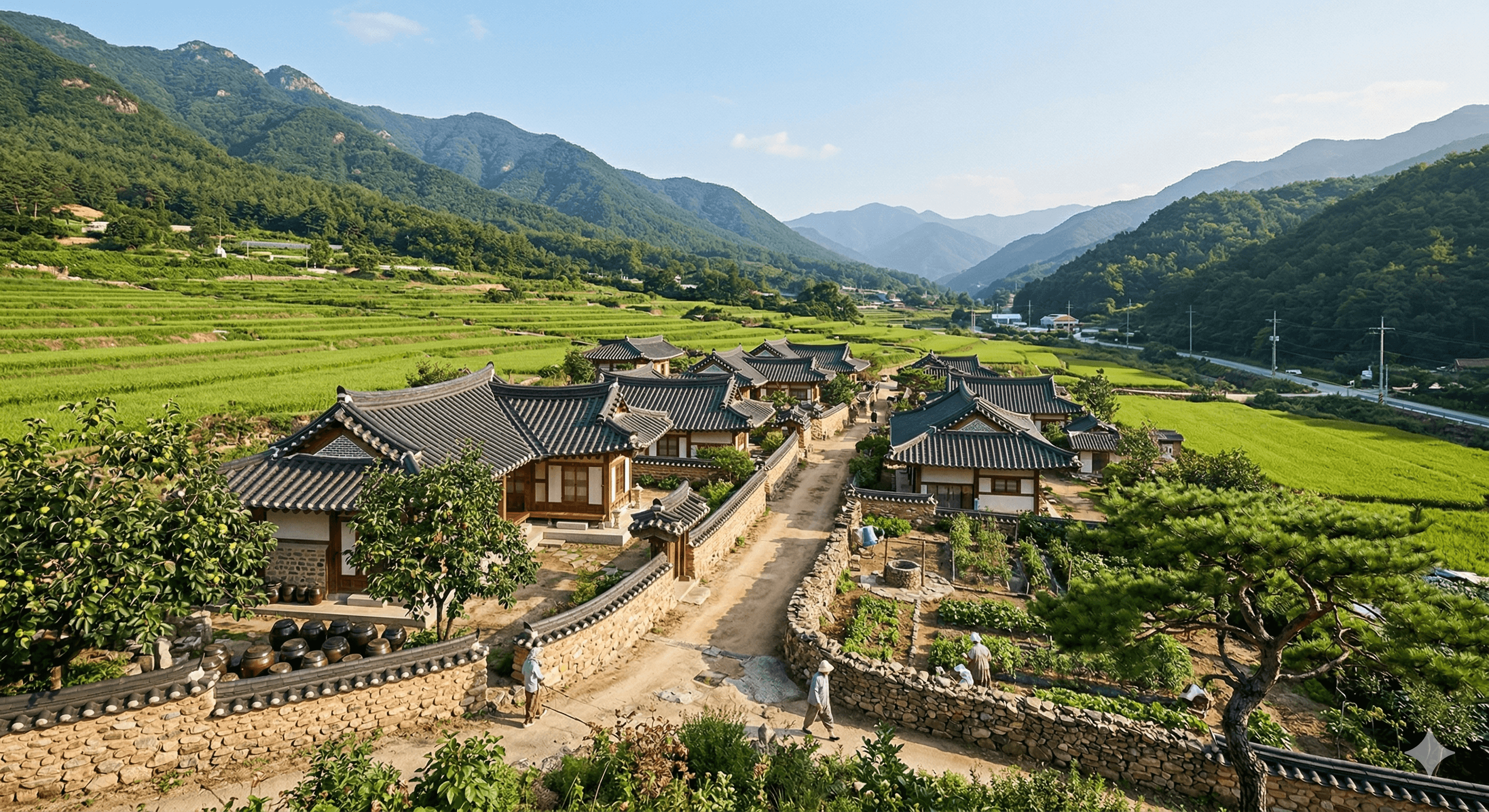
In 2023, a restored hanok guesthouse in Gyeongbuk province sold out every weekend from April through October. The owner was in London. They'd never met a single guest. Their net yield after management fees was over 11%. The property had cost them ₩85 million — less than $65,000 USD — plus renovation.
That's not an anomaly. It's a pattern. And most Western investors have no idea it exists.
The fundamentals are unusually strong
What makes rural Korean property different from other emerging markets:
- Entry prices are low — ₩30–120M ($22K–$90K USD) for a structurally sound 빈집
- Government actively subsidises renovation and incentivises foreign buyers
- Korean tourism is growing — 17.5M international visitors in 2024, up 39% YoY
- Korean cultural exports (K-drama, food, music) have created a global demand for authentic Korean experiences
- STR demand for traditional hanok stays consistently outperforms urban guesthouses on nightly rate
The Korea Wave is a demand engine
Hallyu — the Korean Wave — is real and it has direct implications for rural property. Travellers who fell in love with Korea through its dramas, food, and music don't want to stay in a city hotel. They want the hanok in the mountains. They want the tea house by the river. They want the countryside experience that looks like the shows they watched.
Rural 빈집, properly renovated and positioned, sit directly in the path of this demand. Supply is constrained — there are only so many authentic hanok that have been restored to a high standard. Demand is growing every year. That's a simple supply-demand argument that doesn't require complex modelling.
The visa is the overlooked multiplier
Most property investments in Asia give you an asset. Korean 빈집 investment, structured correctly, gives you an asset and residency rights. The D-8 visa costs no additional money — it's a byproduct of making a qualifying FDI investment. For buyers who have any interest in spending time in Korea, this is a meaningful bonus that no comparable market offers.
The window is open now. As more international attention falls on Korean rural investment, prices will rise and the 빈집 register will shrink. The buyers who move in the next 2–3 years will have the widest selection and the lowest entry points.