
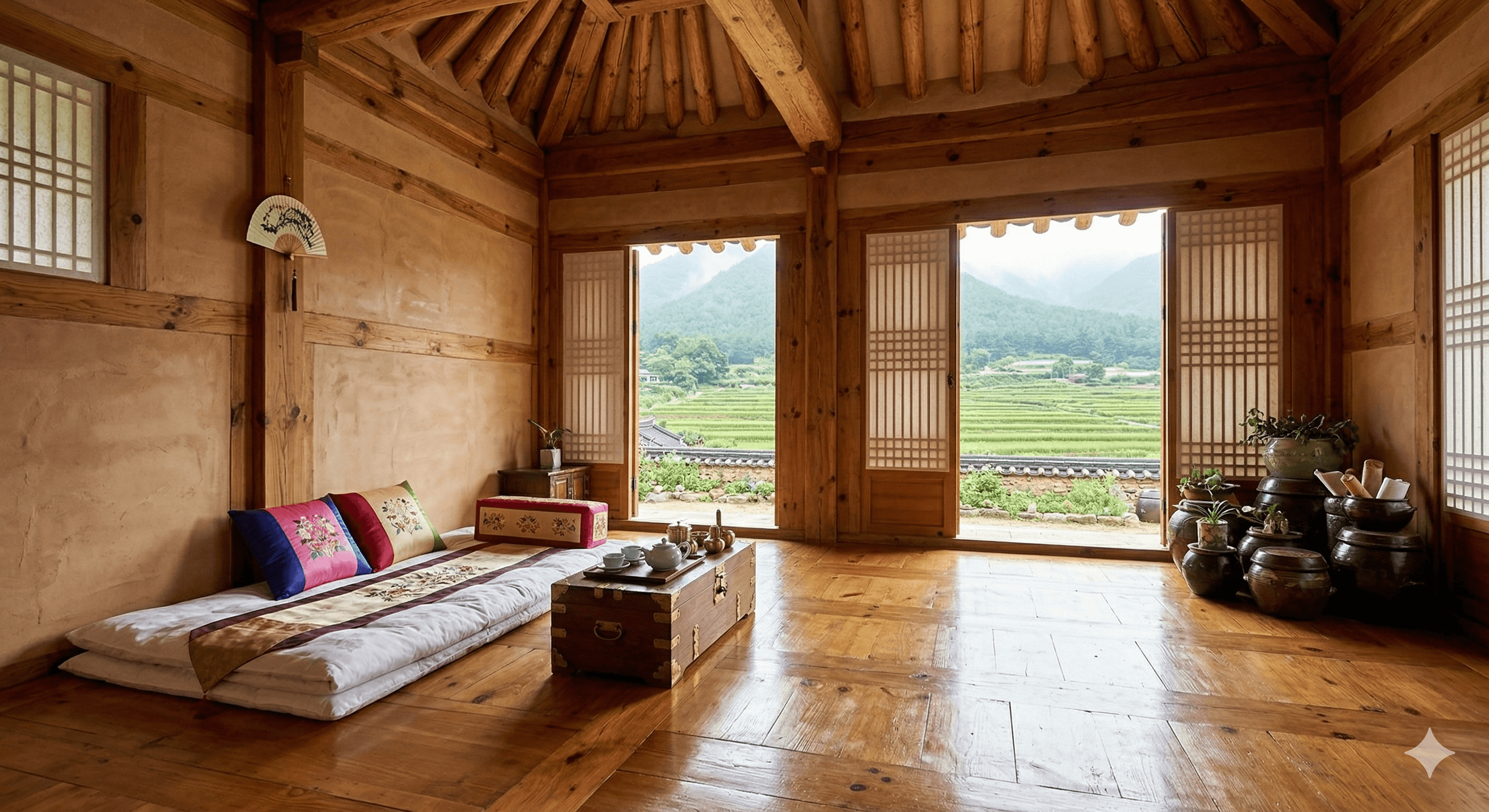
Once you own a 빈집 and have it renovated, you have a choice about how to generate income. You can find a long-term tenant — a local family, a remote worker, someone who pays monthly rent. Or you can run it as a short-term rental — listing it on Airbnb, Booking.com, and Wehome for nightly stays. The numbers on both options are not the same.
The long-term rental case
Long-term rental in rural Korea is predictable. A modest hanok of 60–80㎡ in an accessible rural area might rent for ₩400,000–₩600,000 per month — roughly $300–$450 USD. That's stable income with low management overhead. You find a tenant, sign a lease (jeonse or monthly rent), and collect money.
The problem: ₩500,000/month on a ₩150M total investment (property + renovation + fees) is a gross yield of about 4%. Before tax. It's not bad for a passive investment, but it's not what makes this opportunity exceptional.
The STR case
A well-positioned and well-managed hanok STR in a desirable rural location — near a national park, a traditional village, or a scenic river — can achieve ₩150,000–₩250,000 per night. At 60% occupancy (conservative for a strong property), that's ₩2.7M–₩4.5M per month. Even after our 18% management fee, that's roughly ₩2.2M–₩3.7M net — 4–7x the long-term rental income on the same property.
At 60% occupancy and ₩180,000 average nightly rate, a 70㎡ hanok STR nets approximately ₩2.6M/month after management fees — a gross yield of around 14–18% on a ₩150M all-in investment.
The visa dimension
There's a reason KoreaRoots builds STR into the investment model that goes beyond yield. Your D-8 visa renewal requires proof that your Korean business is generating revenue. A long-term tenant doesn't create the kind of paper trail Korean Immigration wants to see — a residential lease is not business income. STR bookings, platform payouts, and bank deposits are. This matters enormously at the 2-year renewal mark.
When long-term rental makes sense
It isn't always STR. If your property is in a location with weak tourism demand, if the renovation budget is limited, or if you genuinely have no interest in the management overhead — even outsourced — a long-term tenant is a reasonable fallback. We assess every property for STR potential before recommending it. If the STR economics don't work for a specific location, we'll tell you.